
First time buyer deposits in Scotland calculations rarely stay as simple as they look on day one, and that tends to land at the worst possible moment, right after you have found a place you love. You have saved hard. You feel ready. Then a bright two-bedroom property in Lanarkshire goes on the market at offers over £145,000, with a Home Report of £150,000, you get excited, and three weeks later it sells for £15,000 more than the Home Report value. If that sounds familiar, keep reading, because understanding why it happens helps you budget properly and avoid getting caught out at closing date.
You’re not doing anything wrong. Lack of housing stock, combined with lots of buyers chasing the same handful of homes is a classic supply and demand problem, and Lanarkshire is feeling it as much as anywhere. The numbers back this up too.
The Scottish Government’s own housing market review shows residential property sales across Scotland rose from 99,832 in 2024-2025 to 104,339 in 2025-2026, an increase of 4.5 percent. While mortgages advanced to first time buyers grew by an annual 6.0 percent over the same period (Scottish Housing Market Review, Q2 2026). More buyers are active, and they are all competing for a limited pool of homes.
Why Homes in Scotland Sell for More Than the Home Report Says
Every property sold in Scotland has to have a Home Report before it goes on the open market. It has been a legal requirement since December 2008 and includes a Mortgage Valuation Report that gives an independent surveyor’s valuation, alongside an Energy Performance Certificate and a Property Questionnaire completed by the seller (mygov.scot, Home Report guidance).
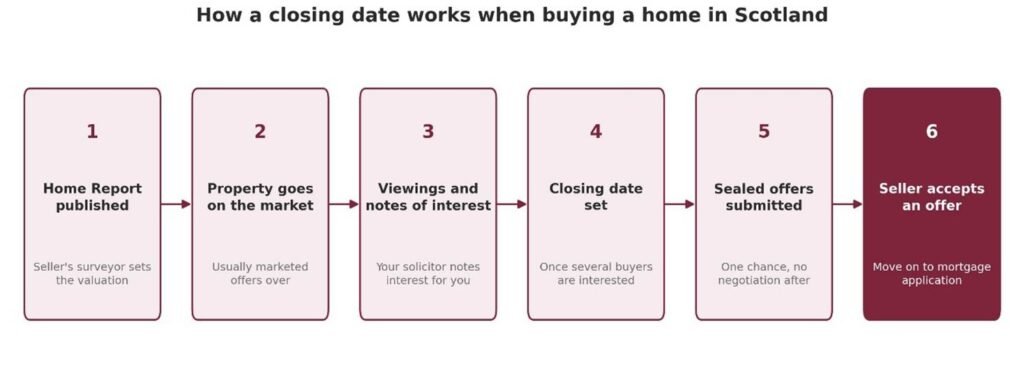
Here is the part that trips people up. Most homes in Scotland are marketed at ‘offers over’ a set price usually below the Home Report Value. The final price depends on how many buyers are interested and how they bid (mygov.scot, buying a home: the legal process). The ‘offers over’ figure grabs attention, it gets viewings booked, and it is not what the property is likely to sell for. In practice, that regularly pushes the final price above the Home Report figure, especially in popular areas.
A lot of that comes down to how buying works here. Once a few people have formally noted interest through their solicitor, the seller can set a closing date, a deadline by which every interested buyer submits one sealed written offer (mygov.scot, making an offer). Because bidders are all working from the same Home Report figure, offers tend to cluster around it and then climb past it, sometimes going as much as 15-20% over the Home Report figure, particularly for popular property types in sought after areas.
First Time Buyer Deposit Scotland: What the Numbers Actually Look Like
Your lender will not simply hand you 90 or 95 percent of whatever you agreed to pay. They base your mortgage on the purchase price or the Home Report value, whichever is lower. Anything you pay above that Home Report figure has to come from your own funds, on top of your deposit.
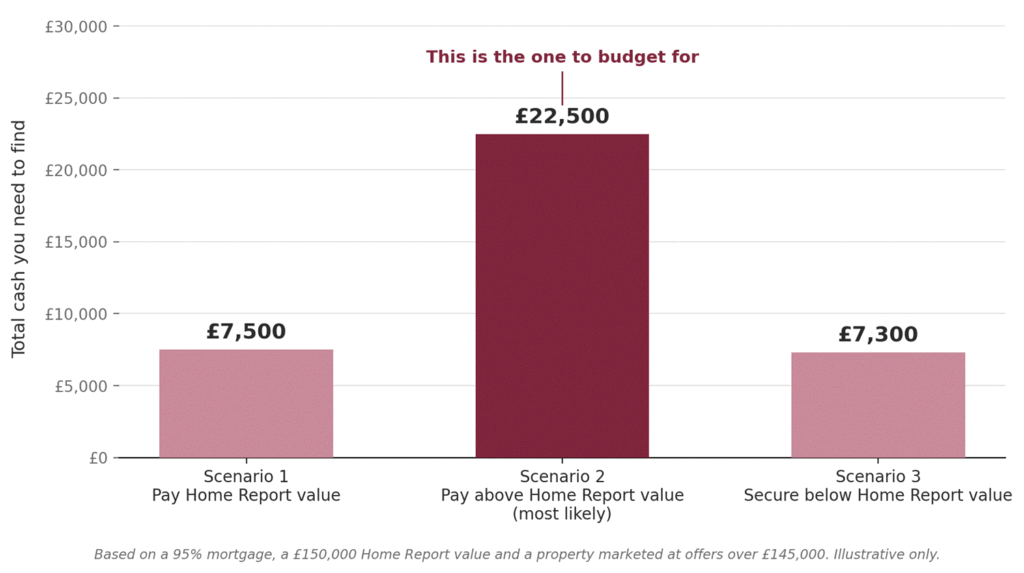
Here’s an example of a property marketed at offers over £145,000 with a Home Report value of £150,000, showing how three different outcomes could play out. All figures assume a 95 percent mortgage.
| Scenario 1: You pay Home Report value | Scenario 2: You pay above Home Report value (most likely) | Scenario 3: You secure it below Home Report value | |
| Marketed as | Offers over £145,000 | Offers over £145,000 | Offers over £145,000 |
| Home Report value | £150,000 | £150,000 | £150,000 |
| Purchase price | £150,000 | £165,000 | £146,000 |
| Mortgage (95%, based on the lower of purchase price or Home Report) | £142,500 | £142,500 | £138,700 |
| Deposit (5%) | £7,500 | £7,500 | £7,300 |
| Extra funds needed above the Home Report. | £0 | £15,000 | £0 |
| Total contribution from you. | £7,500 | £22,500 | £7,300 |
Scenario one is the dream outcome. You pay exactly what the Home Report says the property is worth, your lender bases your 95 percent mortgage on that same figure, and you fund your five percent yourself. Nice and easy.
Scenario two is the reality for most first-time buyers just now. You offer £165,000 for a property with a £150,000 Home Report, to give yourself a fighting chance at closing date. Your lender still only lends against the lower figure, so your mortgage stays at £142,500. That extra £15,000 has to come from you, on top of your deposit, which takes your total contribution from £7,500 to £22,500 on the exact same property.
Scenario three is the rare one, where you actually secure a property under Home Report value, for example at £146,000. Here your lender bases your mortgage on the purchase price rather than the Home Report, since this is the lower figure, so you can borrow 95 percent of that lower purchase price and your total contribution comes in slightly under scenario one at £7,300.
Realistically, if you are buying in Scotland this year, it is sensible to budget for something closer to scenario two. It is by far the most likely outcome and going into a closing date with your eyes open beats being caught short a few days before it.
Same £150,000 Home Report, three very different outcomes
The Good News on Deposits for First Time Buyers
It is not all uphill. Over the past couple of years, several lenders have recognised the pressure first time buyers are under and brought out products needing less than a five percent deposit, and in some cases, no deposit at all, subject to meeting additional criteria such as a strong rental payment history and a robust credit rating. As we move through 2026, we are seeing more innovation from lenders and the Scottish Government with first time buyers in mind.
The Scottish Government’s First Homes Fund
The First Homes Fund reopened for applications in June 2026, offering eligible first-time buyers up to £10,000 towards the cost of a property valued up to £300,000 (gov.scot, First Homes Fund).
It works as a shared equity scheme. In brief:
- Up to £10,000 towards your deposit, with no interest charged
- No monthly repayments on the government’s contribution
- Available on properties valued up to £300,000
- The government takes a proportional equity share in your home, normally repaid when you sell.
It will not suit everyone, and the equity share is worth thinking through carefully, however, for buyers struggling to bridge that deposit gap, it can be a genuine lifeline.
New Development on the 12th of August 2026
The LIFT Open Market Shared Equity Scheme (OMSE) has now reopened and with increased price thresholds which could make homeownership for those on lower incomes more accessible. Read more about this in our follow-up article coming next week.
Talk to Us Before You Make an Offer
It is of ultimate importance that first time buyers get that advice before they offer, not after. We are based in Hamilton and have been actively securing mortgages for our clients. Mark personally has over twenty years’ experience in the industry. If you want to find out how to strengthen your position before you start viewing, our earlier piece on boosting your mortgage affordability is a good next read.
Get in touch with us HERE and let us walk you through exactly what your contribution and your budget really need to look like before you make an offer.
Note – The information contained within is correct at the time of publication but is subject to change.
Your home may be repossessed if you do not keep up with mortgage repayments.